
May 11, 2025
I came across this post on Instagram this morning from one of my favorite accounts, Reichwingwatch. It reads: “We should assume triggering violent resistance is part of Trump’s plan to stay in power indefinitely.” Followed by slides of how various authoritarians and dictators have used false flag events like the Reichstag fire and violent incidents in order to clamp down on dissent with military and overt force in order to further consolidate power.
“Nonviolence is a powerful and just weapon. It is a weapon unique in history, which cuts without wounding and ennobles the man who wields it. It is a sword that heals.” - Martin Luther King Jr.
I am of two minds. Actually more accurately my gut and my mind are split. My gut says that the non-violent resistance isn’t going to cut it this time. My gut feeling is that tensions in the country are at an absolute boiling point and we can’t stand many more outrages before it spills over into real violence. My mind tells me that violence just creates another cycle of violence and that the only true pathway to real, lasting change is nonviolent action.
As I read the words of people like MLK I wonder how much they had to censor themselves on the public stage from what they truly felt in their guts. Please don’t misconstrue this as me comparing myself to MLK. I certainly am not. But I have felt a responsibility with my platforms to not say anything that would set off a cascade of violent action. There’s also the legal concerns too, often fiery political speech skirts the line of incitement and insurrection. If I’m having to think about these things and censor my words to avoid causing violence and avoid legal fallout with my small audience then how much more did people like MLK and other prominent leaders need to think about these issues, and selectively censor their words? What did they feel in their gut versus what they said on a stage in-front of millions? Something to consider.
Why do strikes work? Because they’re disruptive. Because strikes cause real economic harm to the company and a company cannot function and make a profit without the labor to produce their goods and provide their services. Strikes have real consequences. Similarly in order for peaceful protests to be effective they must be disruptive and bring real consequences, or at least the threat of real consequences.
Millions of people marching peacefully down a street brings change not because it’s an inspirational and heart-warming sight that finally melts the frozen heart of the authoritarian and then out of the goodness of his now thawed heart he gives into the demands of the people. No! It’s the implication! The implication that if the regime doesn’t listen to the people then these millions of people will not be so peaceful next time.
Peaceful protests only work because of their implication. It reminds me of this scene from It’s Always Sunny in Philadelphia.
If we want these peaceful protests to really bring change they need to be more disruptive. I’m not saying violent. I’m saying disruptive. That’s why general strikes and strikes are SO effective. They cause economic damage, which gets people’s attention. Because remember, money is a proxy for life. Why are you afraid of running out of money? Because if you run out of money you won’t be able to afford rent, or food. If you run out of money you run out of that essential resource which keep you alive.
This is the same reason people hoard money. More money equals a longer and better quality of life into your old age.
Strikes in their own way are violent. They threaten the very livelihood of individuals. They don’t directly take lives, but think of how many lives have been indirectly taken by lack of money, lack of resources. How many people have died because health insurance companies denied their claims, and then due to their lack of resources they couldn’t afford the care they needed, and then they died. So if you cut off the business owner’s cash-flow and they see that they’re risking insolvency(like Musk with Tesla), then they feel a threat to their livelihood, and there’s enough pressure for them to change their actions.
“Political power grows out of the barrel of a gun” (Chinese: 枪杆子里面出政权) is a phrase which was coined by Chinese communist leader Mao Zedong. The phrase was originally used by Mao during an emergency meeting of the Chinese Communist Party (CCP) on 7 August 1927, at the beginning of the Chinese Civil War.
Never thought I’d be quoting Mao, but here we are. When you get down to it the power of the state is maintained through the barrel of a gun. What happens if you don’t pay your taxes? You start getting letters from the IRS right. They’ll garnish your wages. Eventually if your delinquency grows large enough they’ll seek criminal charges and send police after you. What happens if you don’t comply with the police? They’ll use force to get you to comply. What happens if you resist that force? Eventually, they’ll use deadly force.
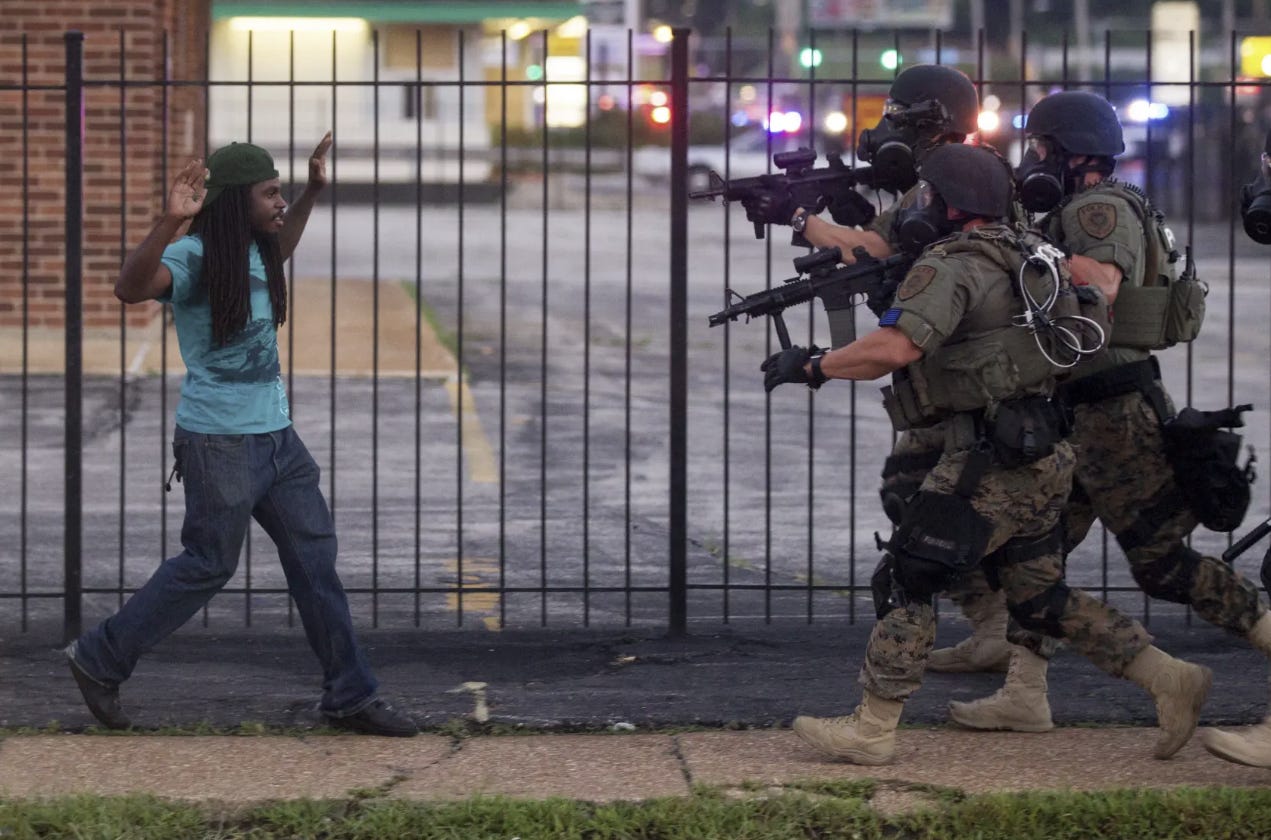
To understand some of the distrust of police that has fueled protests in Ferguson, Mo., consider this: In 2013, the municipal court in Ferguson — a city of 21,135 people — issued 32,975 arrest warrants for nonviolent offenses, mostly driving violations.
A new report released the week after 18-year old Michael Brown was shot and killed in Ferguson helps explain why. ArchCity Defenders, a St. Louis-area public defender group, says in its report that more than half the courts in St. Louis County engage in the "illegal and harmful practices" of charging high court fines and fees on nonviolent offenses like traffic violations — and then arresting people when they don't pay. The report singles out courts in three communities, including Ferguson.
Earlier this year, in the series Guilty and Charged, NPR's investigations unit found that the practices in Ferguson are common across the country. The series reported that nationwide, the costs of the justice system are billed increasingly to defendants and offenders, and that this creates harsher treatment of the poor. Because people with money can pay their hundreds or thousands of dollars in fines and fees right away, they are usually done with the court system.
People who can't pay their fines and fees go on payment plans. But then there are extra fees, sometimes interest — 12 percent on felonies in Washington state — and, if poor people fall behind on payments, they may go to jail. Courts often ignore laws, Supreme Court rulings and protections that outlaw the equivalent of debtors prisons.
https://www.npr.org/2014/08/25/343143937/in-ferguson-court-fines-and-fees-fuel-anger
“Give us a Shout Yeah, We Wouldn’t Want to Smoke a Friendly.”
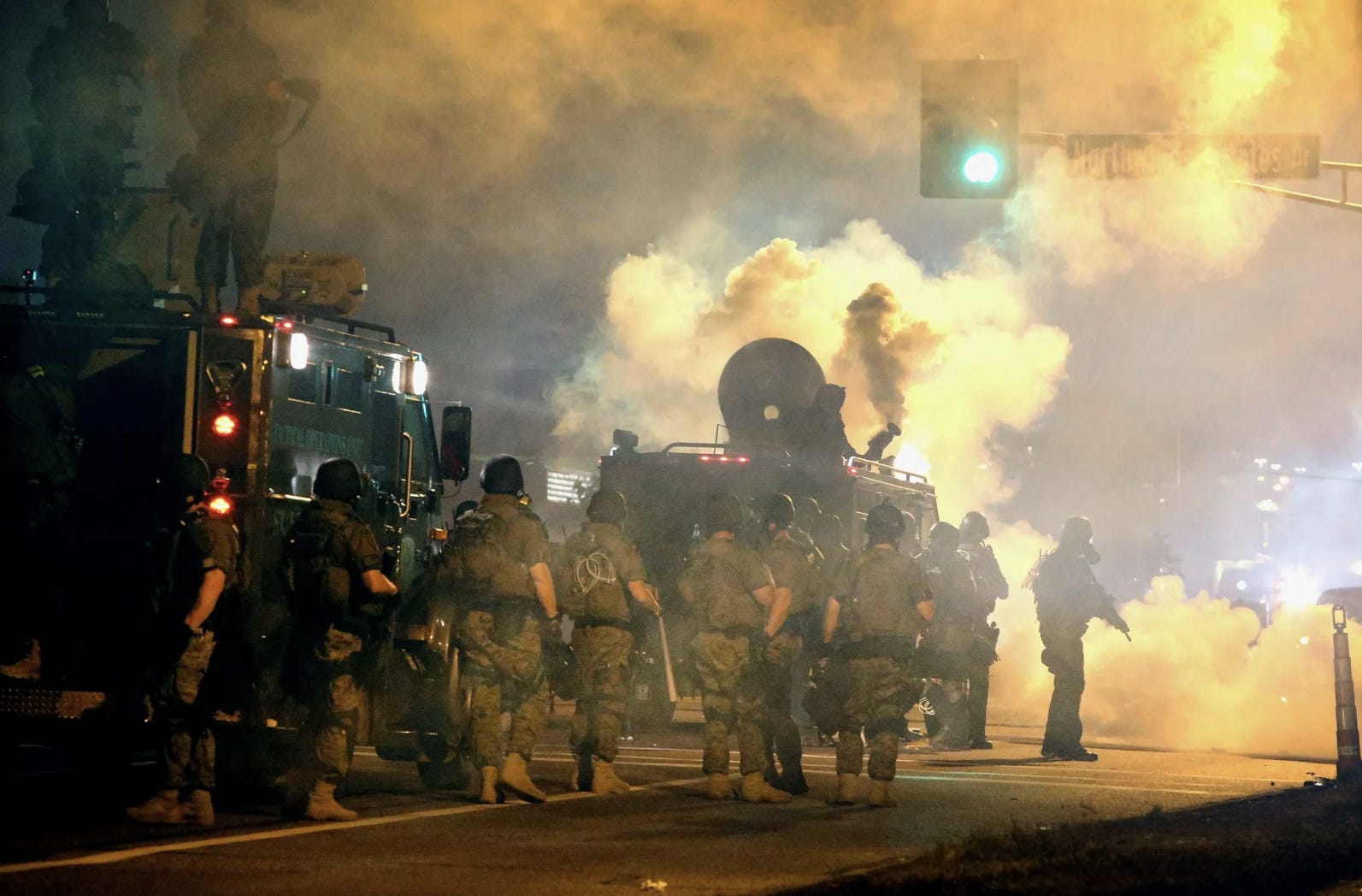
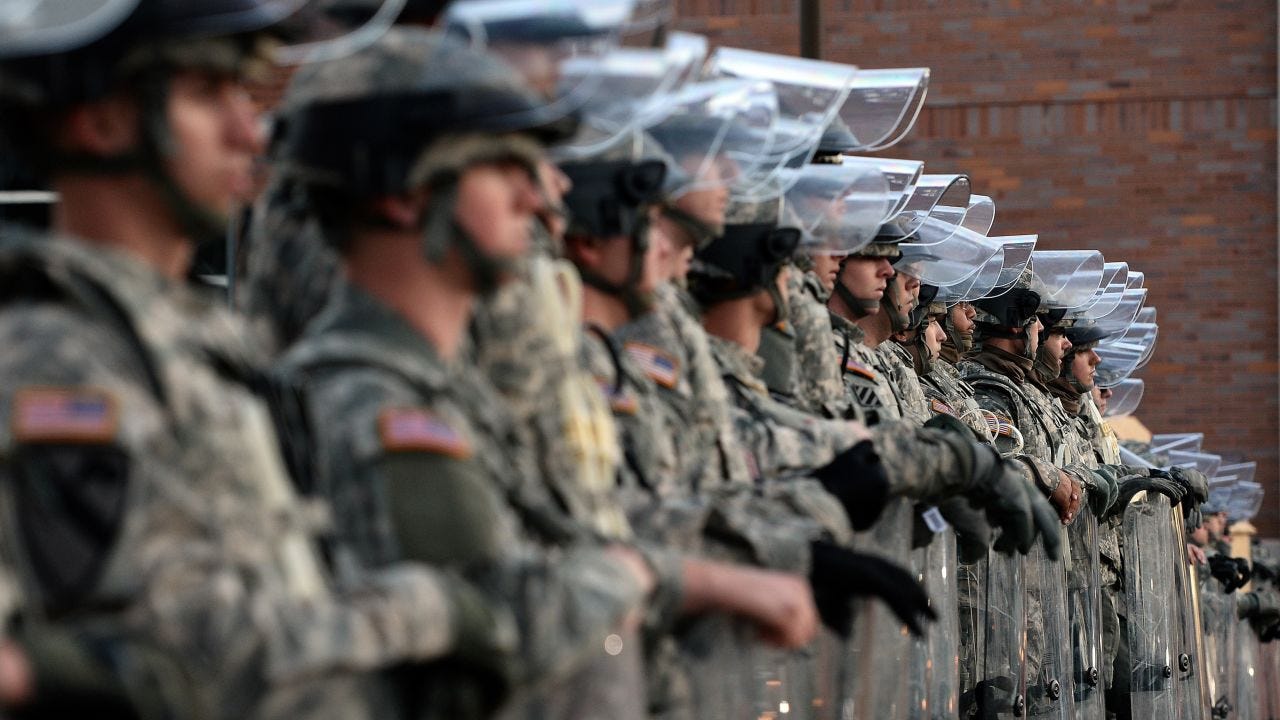
I was deployed to Ferguson, Missouri in the winter of 2014. We were each issued one 30 round magazine of live ammo. We were issued kevlar body armor but ran out of ceramic armor plates. I was thankful to be one of those that didn’t get the heavy and uncomfortable ceramic inserts that were designed to stop high caliber rounds. Sure, if I got shot by a rifle I’d die, but the chances of getting shot by a rifle in the streets of St. Louis, Missouri seemed low enough that I preferred the comfort of only wearing the soft body armor.
We were shocked when the orders came down for us to deploy to Ferguson in support of local law enforcement in clamping down on civil unrest and riots. We were shocked because we’re an infantry company. Our one and only job is to close with and destroy the enemy. And we were being deployed to the streets of St. Louis as a peacekeeping force?
The Ferguson Unrest and Ferguson Riots were a series of several riots and protests triggered by the fatal shooting of Michael Brown, an 18-year-old African American, in the city of Ferguson, Missouri, U.S. by Darren Wilson, a white police officer, on August 9th, 2014.
The unrest reached a breaking point when on November 24, 2014, the grand jury reached the decision to not indict Wilson on any criminal charges. Many of those waiting outside the Ferguson Police Department grew violent and the situation intensified. Multiple buildings were torched and protesters hurled rocks at parked police cars. This continued into the following day when Missouri Governor Jay Nixon deployed the National Guard and reinforced law enforcement presence in the area, effectively bringing the protests to a stop.
https://www.blackpast.org/african-american-history/ferguson-riot-and-ferguson-unrest-2014-2015/
I was put in charge of a four-man fire team that would first guard the parking lot of a mall which had been looted the weeks prior and then we moved to guard a power substation. Our team was paired up with a Military Police(MP) soldier, a Specialist(E4) who drove us around in their humvee. We were considered “light infantry” which meant that we didn't have much in the way of vehicles and didn’t have enough humvees to go around. Light infantry is an oxymoron, like most things are in the military. Light infantry always have the heaviest loadouts because we have to carry everything on our backs.
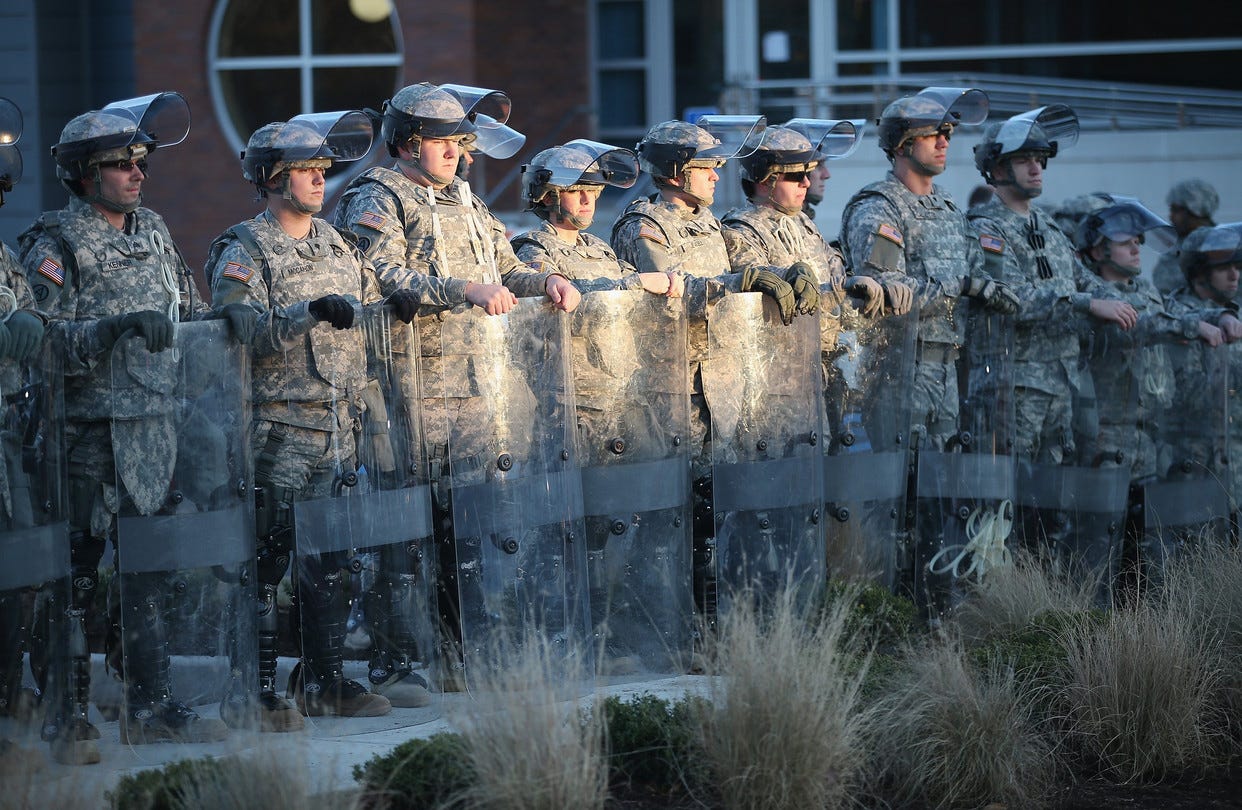
The first day with our new MP driver he was telling us how they’d already been deployed for a week and that whole week was spent in preparation for our arrival. He told us, “they gave us a brief everyday this week about y’all. They told us our job was to make sure y’all don’t shoot nobody.” Valid. I too would be concerned about protestors getting shot if I deployed a bunch of infantrymen on US soil.
We only got one evening of training before we were sent out on various missions. They had each of us fire one shot from a taser. We were now qualified to carry tasers! But in the end, supply didn’t actually have any tasers so no one in our unit was issued one. “Welp, looks like it’s deadly force for us boys.” Joked my first sergeant. I wonder how much of that joke was a real desire to shoot black protestors now. I’ve since learned he’s a real piece of shit and an avid MAGA supporter.
A MP showed us how to use pepper spray. Point the nozzle at the enemy. Push down here. They handed the empty can of pepper spray and had each of us depress the little nozzle to no effect. “You’re now qualified to use pepper spray.” We also didn’t get issued any pepper spray.
“Now y’all, don’t shoot anybody.” Our company commander, a Captain that was in his late 40s said through his heavy southern accent. “I mean it guys you can’t shoot anybody. I’ll get in a whole heap of trouble if you shoot anybody ya hear?” Our Captain was a real piece of shit. I don’t even remember his name now. I just know that the entire time he was in charge of our company he was more concerned with covering his ass from liability and with how good the company made him look to his superiors than with the wellbeing of the soldiers under his command.
A year prior, I was talking with some NCOs about becoming an officer. He overheard and literally pushed away the NCOs I was talking to and stopped the conversation cold to gather my name, social security number, and address so he could put me down in the recruiting system and get paid money for “recruiting an officer” if I did go to OCS. After he collected that information he just left. He didn’t give me any advice, he’d gotten what he wanted - a chance to make easy money, why waste time talking to his soldier? A real selfish scum-bag.
Our time in Ferguson would turn out to be uneventful. We pulled 12hr shifts and sat on our butts. I spent Thanksgiving day playing Final Fantasy XII on my phone in a cold humvee. A family dropped off a sad basket of cold-cut sandwiches. It was only after we ate them that I thought, “hmm, that'd be a great way for people who don’t like the military presence to poison us.”
We were housed in an annex of the St. Louis airport. Someone had set up clearing barrels. The procedure is for every soldier returning from mission to unload their weapon, goto the clearing barrel, a 55 gallon metal drum that’s supposed to be filled with sand, and pull the trigger just to make triple sure that their weapon is unloaded. We had a ND, or negligent discharge every night. Tired soldiers forgot to drop their magazine BEFORE they pulled back the charging handle of their M4, which put a live round in the chamber. Then they went to the clearing barrel and pulled the trigger, firing the round.
The first night this happened the clearing barrels were pointed toward the airport runway. The live bullet zipped through the empty 55 gallon drum and skipped past rows of civilian aircraft. The next night it happened the clearing barrels had been turned around and pointed at our makeshift barracks. The third night someone finally found sand and filled the empty 55 gallon drums. Lee, one of my buddies, was one of the unfortunate soldiers to have a ND. He walked around with a morose look and moped around during the rest of the little deployment. He looked so sad we couldn’t even work up the heart to heckle him.
The day after Thanksgiving we were approached by a group of men armed with AR-15s, they had pistols strapped to drop-leg holsters. They had a mis-matched assortment of body armor and tactical vests. Not unlike how supposed ICE agents look in 2025. Their leader had a stubbly red beard and wore a camo baseball cap and had a little minuteman patch on his plate carrier that reminded me of the National Guard logo. “Hey Sergeant, can I talk to you?”
Their body language was relaxed and their weapons were slung. I didn’t feel a threat from them beyond the threat that any armed person inherently possesses. I told the MP to join me and got out of our Humvee. The MP carried a M9 Beretta, I had my M4. “Yeah what’s up guys, who are you with?”
“We’re Oathkeepers.” Their leader paused, as if expecting me to give him praise or recognition. I stared at him blankly until he continued, “uh yeah we’re Oathkeepers and we’ve been given permission by the owner to protect his business.” He pointed vaguely behind him. “Yeah, they gave us permission to set-up on the roof and protect their property.” The protestors had burned down several businesses in the week preceding the deployment of the Missouri National Guard.
“Uh, alright.” I’d been trained on how to clear enemy combatants out of a building, and how to respond to a near-ambush(dump your mag on full auto, throw grenades and then get shot, probably), but no one had trained me on what to do when paramilitary militiamen show up to LARP as snipers on private property in downtown St. Louis.
“Y’all got live ammo? Y’all wearing plates?” My brain revved into high gear. My threat assessment changed completely. These were probing questions trying to determine our capabilities. These guys just moved up from being MEAL Team Six weirdos to a potential threat.
“Don’t worry about that, we’re good.” I shifted my stance and let my thumb slip surreptitiously to the safety selector of my M4 carbine. Luckily I’d been holding the weapon in a low-ready stance because that’s how we always walked around with our weapons. Maybe our Drill Sergeants knew what they were talking about and weren’t just a bunch of sadistic assholes. Well, they were definitely sadistic assholes, but they also knew what they were talking about.
“Just giving y’all a heads up on what we’re doing. And tonight if y’all are gonna be in the woodline give us a shout yeah, we wouldn’t want to smoke a friendly.”
“What the fuck.” I didn’t voice this thought. “Smoke a friendly?” What the hell was this asshole on about? What does he think he’s going to do up there on that roof? His deranged mind is probably filled with fantasies of shooting black protestors in some last-stand defense of the autoparts shop or whatever random business he was going to heroically protect.
“No man, you’re not going to shoot anybody. What are you talking about? Why the fuck would you shoot somebody that you can’t even identify, just because they’re walking out of the treeline? You’re in goddamn America you fucking asshole, put your fucking hands in the air and drop your weapons!”
That’s what I should have said. That’s what I fantasized about for days after the incident. But back in 2014 I was just a shy 27 year old with a loaded weapon unleashed on the citizens of St. Louis. I was completely out of my depth. I just gave the Oathkeeper another “alright dude” and walked back to the Humvee with my MP in tow. We watched the Oathkeepers drive over to a one story strip-mall and climb onto the roof. They passed up rifles and bags of equipment.
I’m grateful that our MP had more presence of mind and more confidence than I did. He got on the radio and called it in, “Hey yeah some militia guys just set up on a rooftop with ARs and sniper rifles.” A few moments later five police cars rolled in with their lights on. After a few moments of chatting, the Oathkeepers climbed off the roof, packed their equipment into their car, and drove off. In my memory they slunk off like young kids who’d gotten in trouble with their mom, but I’m sure we weren’t close enough to see their body language.
I don’t think black protestors would have gotten off with just a stern warning if they’d set-up on that same roof with AR-15s and sniper rifles. Do you?
It is so strange how these seemingly random experiences in my life are now coming together. If I were writing a book where the character lives through a fascist coup of the US backed by white supremacist militias I might write something like this in their backstory, to give some color and show how the white supremacist militia movement was quietly growing and gathering recruits and momentum for decades before the breakout of the 2nd American Civil War.
But this isn’t a fictional story. This is my real life experience. I’ve had multiple run-ins with these militia assholes. Like Riley, the SPC in our platoon who got arrested for training the militia in Florida. The American Front militia was indicted on federal charges after training to start a “race war.” What a bunch of assholes. They even made ricin, the deadly poison made famous in the show Breaking Bad, and were planning to use it to murder brown people.
ATLANTA (Reuters) - A federal jury on Friday convicted two alleged members of a Georgia militia group with conspiring to produce a toxic agent to poison government officials.
The jury in Gainesville, Georgia, convicted Samuel Crump, 71, and Ray Adams, 57, of conspiring to produce ricin for use as a weapon, according to federal court records.
The two men face a maximum punishment of life in prison, although under federal sentencing guidelines will likely serve less time, prosecutors said.
Now it’s all coming to a head. If this were a book we would be somewhere in the beginning of act two. The stakes are getting higher, we’re nearing the climax. A point of no return, from which the protagonist can no longer go back to the status quo.
QZ, thanks for telling your story. You manage to tag a lot of my concerns.
I think that key to the success of nonviolent action is an ultimately moral authority structure. If the people in charge cannot be shamed then there is no internal governor on their behavior. Nonviolent protest got Ghandi's followers horrific treatment but at some point their British rulers could no longer look in a mirror without shame. Nonviolent protest got students and other civilians in Tiananmen Square hosed with lead and their bodies turned into track-lube; after a good wash-down the next morning it was business as usual for a Party with pride but no conscience.
So where lives the moral spark in America, and can it face its fears? Trump? Bondi? Noem? Holman? Miller? It's not for nothing that we've seen the arrest of a judge and a mayor, and are hearing that legislators are next if they don't STFU.
The various "color revolutions" of the last couple decades have shown that there can be the simplest of tipping points after which the security state crumbles in the face of EVERYBODY. But a critical mass of the society has to decide, "That's it -- I won't take anymore.". And then suddenly, they don't have too. Where is the U.S. tipping point?
The following essay that I published last night is perhaps the most important one that I have published to date in two years of writing here at Substack:
Issued as a Presidential Proclamation on Friday May 9, 2025, not as an Executive Order, Project Homecoming avoids the legal scrutiny, judicial challenge, and procedural friction that typically accompany enforceable federal action. Its form alone reveals its function: to simulate the shape of law without exposing its interior to resistance. It is not a directive; it is a lure.
According to its terms, undocumented immigrants are given sixty days to leave the country “voluntarily.” The government offers free, taxpayer-funded flights and a $1,000 “exit bonus” to those who comply. The CBP Home app, newly launched, allows users to schedule their departure and access “concierge assistance” at participating airports—even if they lack proper documentation. At first glance, the tone is almost civil. Humane, even.
But this is the false flag. There is no intention to honor the offer. The “concierge assistance” is not humanitarian—it is most likely an ICE capture mechanism disguised as transportation help. The app itself is not about aid—it is a precision tracking system that allows DHS to identify, locate, and intercept individuals who make the mistake of trusting it. Project Homecoming’s opening gesture is not a choice. It is a lure designed to feed the enforcement machine.
Meanwhile buried in the same breath is the true mechanism: a trigger date, set just after the Fourth of July, when the offers expire and the enforcement phase begins.
After sixty days, the Proclamation declares, those who remain will face asset seizure, wage garnishment, and criminal prosecution. And the Department of Homeland Security will deploy 20,000 additional agents to carry out arrests and removals. The gentle invitation thus becomes a threat—and that threat is far from rhetorical.
https://robertjrei.substack.com/p/a-homecoming-for-god-a-goodbye-to